I realize that I have been unusually negligent with this blog recently. I think two weeks is more than enough time.
It’s a little difficult for me to remember now what has passed. I left off when I was about to go see the Buena Vista Social Club at the local theatre. The performance was excellent and enlightening, as that is one area of music into which I’ve not really delved.
That Sunday and last Sunday were spent in Christine Perrin’s apartment again, eating lunch with other friends and having good conversation. It was disappointing that she and Catherine needed to leave so soon, but I recognize how lucky I am that they will remain in my life even after being here, a gift that not many of the other students have. They came during a rough period of our group’s history, and especially for me; having them gave me a measure of reliable former context. That is a valuable feeling that cannot be reproduced or imitated by something that is not native to life back home, and it helped me strengthen and heal.
The week (two weeks ago) was the final period of the portrait painting course. During that time my eye really began to change, and even still I look at someone’s face and see how I would reproduce it with patches of color. I thought that I was not good at painting, and maybe that was good, maybe I would not have made the progress I did. But I love it now. In class, we painted Signor Ricetti, a local ancient portly man with a glorious white beard and weathered face. I love my painting, but I will need to finish some of the details when I return to the States. For my final independent project I painted Erin…it still needs work as well. She has an amazingly captivating face, and reproducing the look I wanted was a harder task than I expected.
Abby and I went to Rome last Saturday…it was a good trip, but there were some unfortunate occurrences that made it a very long, and in some cases, frustrating day. I kept getting us lost in the area around Piazza Navona, and there were some major fiascoes with the train schedule. Due to some misdirection, we were told that the only train we could take would depart from the Roma Tiburtina station (as opposed to the convenient one, Roma Termini), and that its only stop on the way to Firenze would be a half hour drive from Orvieto, and that it would be more expensive than the train we’d been planning to take. It turns out that there was another option, but we were not told about it, so we had to beg Laura Menichetti to come pick us up…at midnight. But the highlights of the day were great…wandering into small stores, a picnic in the Borghese gardens, exploring the Galleria Nazionale d’Arte Moderna (since Abby hadn’t seen any of it and I’d only seen the Cy Twombly exhibit), which has a pretty nice collection, and a visit to the Gagosian gallery to see an Anselm Kiefer sculpture show. Walking into that gallery felt like walking out of Rome and into a corner of Chelsea, which was a nice feeling.
This week began our travel writing course with the poet Scott Cairns. I love it. He’s a really down to earth guy who wears sandals, shorts, oxfords, and a pony-tail. His wife is a very lovely person who writes about food, which both of them love. He has excitedly discovered a taste for grappa, and proudly shows us when he gets a good bottle of it. But the course itself is wonderful because it is wonderful to be writing and reading again. Invisible Cities was a perfect warm-up to this class, and to reading Roland Barthes’ Empire of Signs, which is absolutely fantastic so far. The pace has been relaxed so far, and the work is completely enjoyable. Most classes this week, we have gone out into the town at some point to write sketches about the things we see and take in some sun…it’s a time of Orvieto that we had not been able to really see before.
Other than that, the days have been filled with more leisure activities…playing football on Thursday afternoons, trying a fragrant, 8 year Irish whiskey at a new enoteca, celebrating Jake and Lauren’s birthdays at a restaurant last night, Leonardo driving Erin, Jess and her sister and I to Lake Bolsena for an afternoon to swim and lie on the beach. That sort of thing. Summer has dropped onto this region suddenly, and it is hot and sunny perpetually, and life is fresh.
PS, Dr. Romaine from NYCAMS emailed me recently to let me know of the internship they selected for me for next fall...I will be working at the New Museum, on Bowery St. in Manhattan. Apparently it's one of the foremost contemporary art exhibition spaces in NYC, so I'm super psyched about it. Check it out.
PPS. My brother, Stephen, graduated last night. I wish I could have been there, but I'm really proud of him, and excited to see where his life will go. Please congratulate him if you see him!
22 May 2009

08 May 2009
Caravaggio + Zoo + Cy Twombly + Paint + Wine = The Past Week
I am writing this sitting in bed this Friday morning, listening to the Decemberists’ concert from SXSW this year, in which they played through the entirety of the new album. It sounds pretty decent, back more to their old style but harder. So far nothing stands out like some of the songs on The Crane Wife, but I’ll wait until I hear the studio album to make judgments.
Last week on Saturday a smallish group of us ignored the impending doom of the swine flu to brave a trip to Roma. We traveled with our director, Matt Doll, his wife Sharona, and his small children Silas, Ronan, and baby Chiara, because the main event of the day was to go to the zoo! It was a hot and humid day (it actually thunderstormed for half an hour while we were in the zoo) that started incredibly early, but it was well worth it. Matt and a sub-group of students took the early train so that we could see the Caravaggios that we missed last time – the St. Matthew cycle. My life is now complete! The Calling of St. Matthew is extraordinary, a very powerful painting. I was a little surprised at how much I loved the painting facing it on the opposite side of the chapel, the Martyrdom of St. Matthew. It is a very balanced painting compositionally, but also completely violent. The black emotion in the face and tensed and twisting body of the assassin begins a swirling vortex of fleeing figures and reaching angels. There is so little architecture in the painting, and the foreground is essentially a black pit. What struck me the most was how the assassin was set up as such an image of perversion through his act of wrenching St. Matthew’s outstretched arm away from grasping the olive branch of martyrdom that the angel is extending towards him.
Feeling utterly satisfied, we set out towards the zoo, which is contained in the Borghese gardens. It’s a fantastic feeling to now have some idea of what I’m walking past in Roma, knowing that there is a good caffe and here is the Ara Pacis and here is a good wine bar and now we are passing a church with Caravaggios or Michelangelos and we are not stopping to see them again. It is a city loaded with potential.
We had stopped at the open market in Campo del Fiori to assemble a picnic lunch (and eat the best cornetti I’ve had so far) before we quested for Caravaggio, and so we ate in the park after meeting up with the rest of the group at the zoo. Matt prepares the best food, and there were ancient hollowed out trees that we had fun climbing on.
The zoo was decent; the hippos were pretty sweet, and the monkeys were entertaining as always. The seals were not entertaining. The pens were kind of depressing, though, not very well constructed. It was still fun to wander around, though.
When we had about an hour left, I walked out of the zoo and down to the bottom of the hill, where resides the Galleria Nazionale d’Arte Moderna. Luckily I was able to get in for free since I am an art student, because my main intention (given my time limit) was to see the Cy Twombly exhibit that was going on there. I did not know before how much time he had spent in Italy; some of the painting had even been painted at Lake Bolsena, which is not far from Orvieto (we have plans to go there next weekend). The exhibit was alright, not every painting or drawing was really strong, but it was great seeing a body of his work again. I will be returning to Rome for a day next weekend as well (lake one day, Rome the next!) with Abby, and we’re going to go back to the museum and look at the rest of its offerings, as well as stop by the Gagosian gallery to see the Anselm Kiefer show (!).
With the exception of a great wine tasting in the convent last Sunday, the week was largely uneventful, mostly more painting. I am loving this class, and my painting skills have drastically improved over this short time. Catherine Prescott is wonderful. It’s also been great having the Perrins here, Christine and I have had some great conversations about everything. Yesterday in particular was a great day, we “finished” painting Elle Perrin (I’m very pleased with it so far) and played calcio/football/soccer at a local field for an hour or so in the afternoon. I then went down to the Perrin’s apartment to talk with them, which ended up being delightful and extending over dinner time.
Another highlight of yesterday was after dinner when Abby and I went to a highly recommended wine bar in town, Il Vin Caffe. They are serious about their wine there, and we decided to maybe splurge a little bit in the pursuit of la dolce vita. I had a red from Veneto (which was just ok), and Abby had a glass of Grechetto. This is one of the main grapes used in the white Orvieto Classico (the main wine of this area), and has a really tangy citrus taste, slightly bitter – it is the reason I like the Orvieto Classico. I like the pure Grechetto even better, because it is not sweet at all. I ordered a crostini plate with sweet tomatoes, oregano, and some small type of fish. Delicious. Abby and I shared a torta that was chocolate and apricot marmalade, and to compliment it we ordered a glass each of a dessert wine. This is not something I normally get; in fact, I’ve really only tried sips of it at different times in the past. We made the right choice in ordering it. Abby’s tasted (and smelled) like less viscous honey, and I ordered a local specialty – Muffa Nobile. It had been explained to me before that this is made (in a similar way to Canadian ice wine) by leaving the grapes on the vines past the normal harvest time. There is a type of “nobile mold” (muffa nobile) that they cause to slightly rot the grapes on the vines, which shrivels them and brings out the sugars – almost like making wine from raisins. It blew me away. The bouquet was delicious and complicated; there were scents that I had never smelled before. The taste was also wonderful, like apricots and caramel. I will do all I can to bring a bottle home.
Tonight I am going to see the Buena Vista Social Club at the local theatre, courtesy of Catherine Prescott. I’m excited because I’ve heard really great things about them, and they’re pretty famous. So that should be fun.
I think that is all for now. I love you all.
01 May 2009
Firenze, 24.4.09
Last Friday I traveled to Firenze for the day with my dear friends Erin, Abby, Jake, and Josh. Upon arriving we discovered that, because it was the EU’s “Culture Week,” all of the museums were open for free! We had ambitious plans for the day, so this was a great help, saving us around 23 euro in museum admissions and long waits in line (I assume that the lines moved so quickly because there was no jam-up from needing to pay).
Our first stop was at the Palazzo Pitti, a short jaunt across the Arno. We were excited to start the day with a visit to the modern art section of the museum, since we don’t get a great deal of that here; now and then we crave it. We quickly discovered, however, that the term “modern” was being used in the same way that historians use it: as a loose time period beginning in the mid-1700s and extending up to the end of the 19th century. This was very frustrating to me because in art history, the term is used completely differently, referring to a specific time period beginning at the end of the 19th century. While I appreciate the skill of the art coming out of the age of modernity (in the historical sense), I have little personal interest in it.
Palazzo Pitti was not, however, a disappointment (don’t worry Dana! It was a great recommendation). We had thought that the attached Boboli Gardens might make a good 15 minute refresher before we set out for the next museum. The next thing we knew, we had spent about an hour and a half wandering the newly verdant grounds, which were a perfect blend of water, sculpture, manicured lawns and slightly checked growth. We saw about a third of the gardens. The weather was perfect, and after the day of rain before it was wonderful to merely wander in sun and look out over the city from the top of the hill. Hopefully we will be able to return with a picnic lunch and explore the rest of the grounds.
When we finally rolled our pant legs back down and summoned the resolve to leave the gardens, we set out to recross the Arno and visit the Borgello museum. I had been here two summers ago, but I insisted that we add it to our itinerary because no one in our group should miss what it has: Donatello’s David, and the plaques created by Ghiberti and Brunelleschi in the contest over the design of the Duomo’s baptistery doors. David is an incredible piece of early Renaissance sculpture, and is specifically important for Firenze as a symbol of its dominance over other nearby city-states. The plaques, however, stand out even more in my mind because many feel that their creation can be definitively pointed out as the start of the Renaissance.
We next headed up the street to the Accademia, the museum in which are housed Michelangelo’s “enslaved” unfinished sculptures meant for the tomb of Pope Julius II, and, of course, his David. I was very prepared to not be overly impressed with what I thought was likely an unduly popular piece of sculpture; there is plenty of art that is like that, so popular and constantly being thrust into our visual vocabulary, when it really isn’t all that great. This is different. Michelangelo’s David deserves all the recognition it gets. I was prepared to be unimpressed, but woefully unprepared for the opposite effect; it is awing in its grandeur. The photographs do it no justice – it is twice as large as I thought it would be, and is additionally overwhelming because it stands on a pedestal that is above eye-level.
Upon leaving we stopped at a tiny restaurant to grab a panino to go. It was one of the best sandwiches I’ve had in my life, ham with eggplant and a creamy truffle sauce.
Following lunch we stood in line at the Galleria degli Uffizi for two hours. This was not exactly what we wanted, but it ended up being ok because we met an older couple from Toronto, and we traded stories of our travels for the whole time. So the time passed quickly, and soon enough we were inside. The wealth of art that is inside that building is staggering. The halls are lined with statues like Roman replicas of the Doryphoros, and each room contains some of the most famous works of art in the world. Highlights: the room with the Madonna enthroned altarpieces by both Giotto and Cimabue, Rembrandt portraits, a giant Da Vinci cartoon, Caravaggios. The greatest highlights, though, were seeing the Artemesia Gentileschi Judith Slaying Holofernes painting next to the Caravaggios and actually liking it better than the Caravaggios (!), and the Botticelli room. Primavera and The Birth of Venus are two of the greatest paintings I have ever seen. I suppose what draws me to them is that they are paintings that look like drawings, but it is also the extreme delicacy and precision, especially in Primavera; as dark as that painting is, the whole thing communicates weightlessness, the uplifting spirit of spring. The intricacy of the patterns on the fabric, the small details all add up to a massive painting that is about what is tiny. And then, The Birth of Venus…another artwork that bombards us almost daily, but once again with good reason. After seeing it in person, I am convinced that it is the loveliest treatment of the female form that I have seen. It kills me that this room will in such a short time become inaccessible to me; it is the type of museum space to which pilgrimages should be made as often as possible.
What was NOT a highlight was seeing Parmigianino’s Madonna with the Long Neck. I had wanted to go my whole life with never seeing this monstrosity in person, but the kind folks at the Uffizi just had to place it at a point through which passage was necessary to see half of the museum. What an abomination.
When we had exhausted the Uffizi, we took a quick trip to H&M, where I did not buy anything (be proud, Mom and Dad!). On the way back to Sta. Maria Novella for our 7.13 train, we ordered gelato at Corona’s Café – it was the best gelato I’ve had, I was essentially eating a cold, creamy mango.
I cannot pretend to judge Firenze on the few short times I’ve been there, but the impression it has made on me is this: what is sincere and (relatively) permanent is old and kept inside, and it is from these objects that the city continues to derive its identity and its sincerity. Firenze is a fashion center in every meaning of the word: Italian designers have their flagship stores in this city, even if all the work is done in Milan. The streets are wide and clean, shops abound, there is a sense of a congruous fusion of medieval and modern (unlike so many of the Shakespeare plays done today) in the look of the place. However, take away the Botticellis and the Donatellos and what does Firenze have that is not transitory? Perhaps it is simply what every other city has, but since other cities do not have the start of the Renaissance, this all becomes more apparent. It is interesting to me that what is contained within walls and behind laser beams is the heart of the city. Firenze is, perhaps, still a Renaissance city, and it has not yet been re-birthed as other cities continuously are.
25 April 2009
Invisible City: Napoli
See the monastery, beaten by water and frozen water. It is ancient, two months old now but several years in imagination and centuries in writings. There is the sink where rushing water and soap work to remove oil and pigment. Listen to the echoes of hymns off of white plaster, and you know all the words, and you sing along with them over the sound of cleaning, Casting down their golden crowns around the glassy sea. Hymn 100, and you remember it as a joke and a nuisance, suggested every week and sung every week because of its number and because small children love it. And now you love it because it is old and found true, and the thunder directly overhead obscures it but does not interrupt it.
See the fields of Orvieto last week on a warm day when disaster was announced and all were shaken and one was not there, and you were not to blame and everyone says this but it is not enough. Feel the brown cliffs carved away standing behind you and watch the wind move the fields so that they flow away but stay where they have been for centuries, used and not used in turn. Now they are used for distraction and comfort. They are far below and will soon be experienced but will not have the same presence unless seen from far above.
See the room in Venice where excess revealed what is good and the reminder was almost lost but was in the dizzying gold of the cathedral, and the water flowed around, beauty and undoing, release and entrapment so that your mind knows a new way to conceive of its place, and also your soul.
See the earth that is not there but for tiny islands until you walk out and find it to be there. Walk out.
~
I am reading Italo Calvino's book Invisible Cities, and it is excellent.
This past weekend ended two intense weeks of drawing, in which more than just my drawing changed. Without going into an inappropriate amount of detail, I will say that I realized two weeks ago that some aspects of my life were not true and good, and I began to work to change that. My drawing followed suit, and so Holy Week really became that (holy) for me. I started to turn a corner that is still being turned. And yet, last week something traumatic happened here (again, I’m withholding details because they are sensitive and personal to some) that worked to correct a negative influence on our program, but was still painful for everyone. Please continue to pray for healing out of this. So the last two weeks were full of intense work, spiritual juggling, and physical and emotional exhaustion.
It may seem somewhat strange, then, that I chose to go with my friends Jake, Jana, and Allyson to Napoli. This city is infamous for being dirty and filled with crime, home of Mafiosi and scooter-driving purse-snatchers. It is an intense city to be sure, but there is also a great amount of art and other cultural activities. I had been in the area two years ago, but only in the Amalfi coast region, Pompeii, and Capri, below the city. This was going to be a totally new experience for me.
Because we had come out of such a packed time, we decided to take things as slowly as we could. We arrived via train around 4, and hiked halfway across the city to our hostel, Giovanni’s Home. We of course had no idea what to expect from the hostel, since each is so different, but we had seen that it got great reviews and was fairly cheap. Giovanni welcomed us in, gave us water, and proceeded to give us a map, a book about Napoli, and loads of information about all there was to do in the city, with a brief history lesson for each thing. He drew on our map where we should go, which parts were dangerous, and where the best pizza was. He reassured us about the crime rates, which were on the whole fairly low compared to many other cities in Italy (Rome had 3 times as many reported petty thefts), and explained that out of all the killings that year, only three were not Mafia related. Despite that, he warned us against going into the Quartiere Spagnoli on the west side of the city, which has such a fine grid of tiny crisscrossed streets that the police simply cannot control it. It was kind of interesting later on to be walking on the larger street that ran along the area’s border, and have this dangerous zone right next to you…kind of the same sort of thrill that comes from playing with fire.
But back to Giovanni…the man is a saint. Not only did he provide us with all that help, but he cooked us amazing food that evening after we came back from looking at some of the major churches. He served us and the few other hostel companions wine and then pulled out his guitar and taught us “Funiculí Funicula” and played some American classics. We began to see why Hostelworld had titled him “most fun” a few years ago.
The next morning we basically just walked around the city…into an old castle, looking for comfortable shoes for Jana in the fashion district, stopping in Zara, looking at Mount Vesuvius while eating enormous pannini made of buffalo mozzarella and tomatoes. In the early afternoon we took a short tour of the Teatro di San Carlo, the oldest continuously active opera house in Europe (which, I imagine, means the whole world). It was absolutely gorgeous inside, six tiers of boxes and a stage as big as the audience space. Apparently musicians who are in high demand consider it an honor to perform there, and many have made it their only stop in Italy. We noticed that there was a Mozart opera playing that evening, and were informed that student rush tickets for 15 euro would be available an hour before the performance…upon this good news, we decided to accept the fact that we would be woefully underdressed, and do all that we could to get tickets.
After relaxing a little bit back at the hostel, we ate a quick meal of pizza followed by limoncello and walked back to the theatre to get tickets. Even though we were about half an hour too early for the student time, the man in the box office gave us tickets anyway, and we were able to secure a fourth floor box all to ourselves, stage left. The opera was Mozart’s Die Entführung aus dem Serail (The Abduction from the Seraglio). The gist is that the main character’s lover, Kostanza, and one of his servants and one of her servants were captured by a caliph and forced to join his harem. The servant in charge of the harem is an evil man, the main character tries to get his lover back, etc. etc. The opera was actually one of Mozart’s earlier operas, and greatly influenced what became new trends in the German take on the form. The music was, of course, excellent, and that theatre is one of the best acoustically…as far as I could tell, there was no electronic amplification.
The staging, however, was updated to modern times, and was (as Jake likes to describe it) as if Lil John and Snoop Dogg had recycled the music and reset the stage. All the action took place on a giant revolving yacht (replacing the caliph’s house) placed center stage, which was pretty cool, but then the evil servant came out with five very scantily clad sunbathing women. From there it went downhill…the main character works his way onto the boat by bringing a bag of cocaine, and at the end of the second act and right before intermission, as the sun bunnies were gyrating to Mozart’s crescendoing strings, one of the women took off her top and then walked into the boat’s interior. It was so out of place and so unnecessary, and combined with the late time, we decided to take a taxi back to the hostel. Very disappointing for sure, but the voices and music were still excellent and the experience of attending an opera in a place like that is to die for.
Sunday morning we attended a long-winded mass at a gaudy baroque church (I missed San Giovanale), accompanied by Giovanni and Steve, one of the guys we’d befriended at the hostel. Giovanni took us to a pasticceria to get our morning’s sfogliatelle and cappuccini (sfogliatella is a Neapolitan pastry made with light dough and ricotta cheese, and are unspeakably delicious). He very graciously paid for us and went back to the hostel, while Steve came with us to the MADRE, Napoli’s modern and contemporary art museum. The collection was great, and had some more unusual or atypical pieces by some of my favorites, like Richard Serra (I had no idea he sculpted with thick cloth). The piece that stood out to me most was Dark Brother by Anish Kapoor. It was a giant very dark blue rectangle on a stainless steel floor…but all of a sudden your mind began to question what it saw, since it appeared that there was more to this piece. I suspected, but my suspicions were not confirmed until I asked one of the docents standing near: it was in fact a 3 meter deep hole, painted and formed in such a way as to give the illusion of not being a hole. Kapoor’s work is fantastic, and they also had another (simpler) piece by one of my current favorites, Olafur Eliasson. There was also a large retrospective of an Italian conceptual artist with whom I wasn’t familiar, Alighiero Boetti. His work was lovely, and spoke to me because it was all about grids and permutations of things, anything. I love those very simple concepts that can be carried out in almost endless different forms.
Upon returning to the hostel, Giovanni once again cooked for us: linguini with squid, died with the squid ink! The dark purple may not have looked the most appetizing, but I loved it. Definitely the most unique meal I’ve had here so far. After lunch we went for a final long walk around the city, and then had a long train ride back to Orvieto, late Sunday evening.
The whole weekend was great…Napoli, while admittedly dirty in many parts, had a tremendous beauty that the grit made unlike the “normal” Italian look. The streets were narrow, tall, and dark, with all manner of railings and balconies and sheets hung off the walls. The smells would cycle through trash to steaming sfogliatelle to old fish to clean wood to excrement to basil and garlic, and back again. The traffic was ten times more insane than in Rome. There was graffiti everywhere, but it was for the most part very artistic, and really wacky! It felt like a real city to me, and it was nice to be back in a truly urban space. Not only that, but the company was great. Jake is by far one of my best friends here, Jana comes from a classical schooling tradition and knows what to read and is up for a good conversation anytime, and Allyson is smart and fun to hang out with. All in all, a good close to the “semester.” You can see photos from the trip by clicking on this link (it works even if you don't have Facebook): http://www.facebook.com/album.php?aid=87030&id=537430582&l=249a37cfd5
Portrait painting with Catherine Prescott started on Monday, and we dove straight in. Everyone, including myself, has already made a great amount of progress in just these few days, and I like discovering that oil paints are for some reason a very fast and loose and just comfortable medium for me. It’s very exciting, and I can’t wait to see where we go with this.
Speaking of art, I’ve been reading a lot of different articles and such that I brought with me on art criticism and history and the like. As always, it makes me excited to read more by other people that these articles mention. I read a fascinating review of Vija Celmins’ work (which was a wonderful discovery for me) by James Romaine. He will be my main adviser/professor/mentor in my art history and criticism studies at NYCAMS in the fall.
Did I mention NYCAMS before? My friend Erin (who is here in Italy as well) and I found out a couple weeks ago that we officially were accepted into the New York Center for Art and Media Studies for next semester! So in the fall I will be living in Brooklyn Heights and taking classes in middle Manhattan, along with an internship of some sort. I’m extremely excited about that…it seems to essentially be like a semester of grad school in New York City while an undergraduate. The best thing.
Yesterday we went to Florence for the day…I’ll write more about that soon. For now, I’ll close this long overdue post with some images from my drawing class.
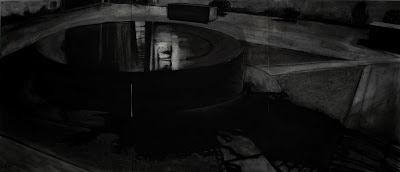
This is my final drawing, on three sheets...it's of a really sweet minimalist well in a recently redesigned piazza in Orvieto (the most modern spot i could find!).
Here is an image of our second to last critique on two separate drawings we did, a still life and a Caravaggio-esque chiaroscuro drawing somewhere in the monastery.

My Caravaggio drawing...

See the fields of Orvieto last week on a warm day when disaster was announced and all were shaken and one was not there, and you were not to blame and everyone says this but it is not enough. Feel the brown cliffs carved away standing behind you and watch the wind move the fields so that they flow away but stay where they have been for centuries, used and not used in turn. Now they are used for distraction and comfort. They are far below and will soon be experienced but will not have the same presence unless seen from far above.
See the room in Venice where excess revealed what is good and the reminder was almost lost but was in the dizzying gold of the cathedral, and the water flowed around, beauty and undoing, release and entrapment so that your mind knows a new way to conceive of its place, and also your soul.
See the earth that is not there but for tiny islands until you walk out and find it to be there. Walk out.
~
I am reading Italo Calvino's book Invisible Cities, and it is excellent.
This past weekend ended two intense weeks of drawing, in which more than just my drawing changed. Without going into an inappropriate amount of detail, I will say that I realized two weeks ago that some aspects of my life were not true and good, and I began to work to change that. My drawing followed suit, and so Holy Week really became that (holy) for me. I started to turn a corner that is still being turned. And yet, last week something traumatic happened here (again, I’m withholding details because they are sensitive and personal to some) that worked to correct a negative influence on our program, but was still painful for everyone. Please continue to pray for healing out of this. So the last two weeks were full of intense work, spiritual juggling, and physical and emotional exhaustion.
It may seem somewhat strange, then, that I chose to go with my friends Jake, Jana, and Allyson to Napoli. This city is infamous for being dirty and filled with crime, home of Mafiosi and scooter-driving purse-snatchers. It is an intense city to be sure, but there is also a great amount of art and other cultural activities. I had been in the area two years ago, but only in the Amalfi coast region, Pompeii, and Capri, below the city. This was going to be a totally new experience for me.
Because we had come out of such a packed time, we decided to take things as slowly as we could. We arrived via train around 4, and hiked halfway across the city to our hostel, Giovanni’s Home. We of course had no idea what to expect from the hostel, since each is so different, but we had seen that it got great reviews and was fairly cheap. Giovanni welcomed us in, gave us water, and proceeded to give us a map, a book about Napoli, and loads of information about all there was to do in the city, with a brief history lesson for each thing. He drew on our map where we should go, which parts were dangerous, and where the best pizza was. He reassured us about the crime rates, which were on the whole fairly low compared to many other cities in Italy (Rome had 3 times as many reported petty thefts), and explained that out of all the killings that year, only three were not Mafia related. Despite that, he warned us against going into the Quartiere Spagnoli on the west side of the city, which has such a fine grid of tiny crisscrossed streets that the police simply cannot control it. It was kind of interesting later on to be walking on the larger street that ran along the area’s border, and have this dangerous zone right next to you…kind of the same sort of thrill that comes from playing with fire.
But back to Giovanni…the man is a saint. Not only did he provide us with all that help, but he cooked us amazing food that evening after we came back from looking at some of the major churches. He served us and the few other hostel companions wine and then pulled out his guitar and taught us “Funiculí Funicula” and played some American classics. We began to see why Hostelworld had titled him “most fun” a few years ago.
The next morning we basically just walked around the city…into an old castle, looking for comfortable shoes for Jana in the fashion district, stopping in Zara, looking at Mount Vesuvius while eating enormous pannini made of buffalo mozzarella and tomatoes. In the early afternoon we took a short tour of the Teatro di San Carlo, the oldest continuously active opera house in Europe (which, I imagine, means the whole world). It was absolutely gorgeous inside, six tiers of boxes and a stage as big as the audience space. Apparently musicians who are in high demand consider it an honor to perform there, and many have made it their only stop in Italy. We noticed that there was a Mozart opera playing that evening, and were informed that student rush tickets for 15 euro would be available an hour before the performance…upon this good news, we decided to accept the fact that we would be woefully underdressed, and do all that we could to get tickets.
After relaxing a little bit back at the hostel, we ate a quick meal of pizza followed by limoncello and walked back to the theatre to get tickets. Even though we were about half an hour too early for the student time, the man in the box office gave us tickets anyway, and we were able to secure a fourth floor box all to ourselves, stage left. The opera was Mozart’s Die Entführung aus dem Serail (The Abduction from the Seraglio). The gist is that the main character’s lover, Kostanza, and one of his servants and one of her servants were captured by a caliph and forced to join his harem. The servant in charge of the harem is an evil man, the main character tries to get his lover back, etc. etc. The opera was actually one of Mozart’s earlier operas, and greatly influenced what became new trends in the German take on the form. The music was, of course, excellent, and that theatre is one of the best acoustically…as far as I could tell, there was no electronic amplification.
The staging, however, was updated to modern times, and was (as Jake likes to describe it) as if Lil John and Snoop Dogg had recycled the music and reset the stage. All the action took place on a giant revolving yacht (replacing the caliph’s house) placed center stage, which was pretty cool, but then the evil servant came out with five very scantily clad sunbathing women. From there it went downhill…the main character works his way onto the boat by bringing a bag of cocaine, and at the end of the second act and right before intermission, as the sun bunnies were gyrating to Mozart’s crescendoing strings, one of the women took off her top and then walked into the boat’s interior. It was so out of place and so unnecessary, and combined with the late time, we decided to take a taxi back to the hostel. Very disappointing for sure, but the voices and music were still excellent and the experience of attending an opera in a place like that is to die for.
Sunday morning we attended a long-winded mass at a gaudy baroque church (I missed San Giovanale), accompanied by Giovanni and Steve, one of the guys we’d befriended at the hostel. Giovanni took us to a pasticceria to get our morning’s sfogliatelle and cappuccini (sfogliatella is a Neapolitan pastry made with light dough and ricotta cheese, and are unspeakably delicious). He very graciously paid for us and went back to the hostel, while Steve came with us to the MADRE, Napoli’s modern and contemporary art museum. The collection was great, and had some more unusual or atypical pieces by some of my favorites, like Richard Serra (I had no idea he sculpted with thick cloth). The piece that stood out to me most was Dark Brother by Anish Kapoor. It was a giant very dark blue rectangle on a stainless steel floor…but all of a sudden your mind began to question what it saw, since it appeared that there was more to this piece. I suspected, but my suspicions were not confirmed until I asked one of the docents standing near: it was in fact a 3 meter deep hole, painted and formed in such a way as to give the illusion of not being a hole. Kapoor’s work is fantastic, and they also had another (simpler) piece by one of my current favorites, Olafur Eliasson. There was also a large retrospective of an Italian conceptual artist with whom I wasn’t familiar, Alighiero Boetti. His work was lovely, and spoke to me because it was all about grids and permutations of things, anything. I love those very simple concepts that can be carried out in almost endless different forms.
Upon returning to the hostel, Giovanni once again cooked for us: linguini with squid, died with the squid ink! The dark purple may not have looked the most appetizing, but I loved it. Definitely the most unique meal I’ve had here so far. After lunch we went for a final long walk around the city, and then had a long train ride back to Orvieto, late Sunday evening.
The whole weekend was great…Napoli, while admittedly dirty in many parts, had a tremendous beauty that the grit made unlike the “normal” Italian look. The streets were narrow, tall, and dark, with all manner of railings and balconies and sheets hung off the walls. The smells would cycle through trash to steaming sfogliatelle to old fish to clean wood to excrement to basil and garlic, and back again. The traffic was ten times more insane than in Rome. There was graffiti everywhere, but it was for the most part very artistic, and really wacky! It felt like a real city to me, and it was nice to be back in a truly urban space. Not only that, but the company was great. Jake is by far one of my best friends here, Jana comes from a classical schooling tradition and knows what to read and is up for a good conversation anytime, and Allyson is smart and fun to hang out with. All in all, a good close to the “semester.” You can see photos from the trip by clicking on this link (it works even if you don't have Facebook): http://www.facebook.com/album.php?aid=87030&id=537430582&l=249a37cfd5
Portrait painting with Catherine Prescott started on Monday, and we dove straight in. Everyone, including myself, has already made a great amount of progress in just these few days, and I like discovering that oil paints are for some reason a very fast and loose and just comfortable medium for me. It’s very exciting, and I can’t wait to see where we go with this.
Speaking of art, I’ve been reading a lot of different articles and such that I brought with me on art criticism and history and the like. As always, it makes me excited to read more by other people that these articles mention. I read a fascinating review of Vija Celmins’ work (which was a wonderful discovery for me) by James Romaine. He will be my main adviser/professor/mentor in my art history and criticism studies at NYCAMS in the fall.
Did I mention NYCAMS before? My friend Erin (who is here in Italy as well) and I found out a couple weeks ago that we officially were accepted into the New York Center for Art and Media Studies for next semester! So in the fall I will be living in Brooklyn Heights and taking classes in middle Manhattan, along with an internship of some sort. I’m extremely excited about that…it seems to essentially be like a semester of grad school in New York City while an undergraduate. The best thing.
Yesterday we went to Florence for the day…I’ll write more about that soon. For now, I’ll close this long overdue post with some images from my drawing class.
This is my final drawing, on three sheets...it's of a really sweet minimalist well in a recently redesigned piazza in Orvieto (the most modern spot i could find!).

Here is an image of our second to last critique on two separate drawings we did, a still life and a Caravaggio-esque chiaroscuro drawing somewhere in the monastery.

My Caravaggio drawing...

11 April 2009
Music Part 2
I did end up going to the concert on Thursday evening as well, which was held at 9 pm in the same place as before. This time the same pianist as before accompanied a mezzo-soprano in four lieder from “Wilhelm Meinster” written by Goethe and composed by Franz Schubert. It’s been a while since I’ve heard sung German (in a classical music context), and I love it. The soprano’s voice was rich, with the perfect amount of vibrato (some, but not a ridiculous amount, which annoys me after a while), and filled the space and was well matched and balanced by the piano. I’m always a little worried when I consider going to see a purely soprano performance, and that’s probably influenced by most of those taking place in a college context, but from the beginning I was set entirely at ease.
One of the gentlemen in the crowd was the composer of the next three songs, which were very modern without being all that innovative, and so they kind of annoyed me. They were also a little destructive to the soprano’s voice. The really crazy thing, though, was that halfway through the last one, I began to feel off-balance. I quickly realized that everyone seemed to be feeling the same thing, and that the curtains on the tall windows were being rocked back and forth. Being in a large room about three stories off the ground during an aftershock (it registered as 4.9 at the epicenter) was unlike any experience I’ve had before. We’ve had other aftershocks here, but I hadn’t felt any yet; people asked me what it was like, and did it make a sound. I always expected to feel a sort of up and down vibration, as from a massage chair, accompanied by a rumbling sound, but neither was the case. Instead, it felt as though whatever was wrong with the world at that moment was inside you, that everything outside of you stayed in place but that you yourself were being gently moved back and forth; in the same way, there was no sound but what came from within yourself, not as a rumbling but as the deepest, sustained tone that could only be heard the way Beethoven heard.
The amazing thing is that neither the pianist nor the soprano missed a beat! (Neither did they when the guy in front of me couldn’t find his sharply ringing cell phone, and then sat and read the text when he finally found it…I wanted to strangle him) The rest of the concert continued without incident. There were four songs in Italian by F.P. Tosti, whom I’d never heard of, which were very lovely, especially the last one Che dici, o parola del Saggio? Following these were two songs by Brahms, Meine Liebe ist grun and Minnelied. They encored with a perfect, light song by Schubert, op. 32 Die Fiorelle.
Speaking of encores, I forgot to mention that the pianist and clarinetist encored at the last concert with a Gershwin piece, Prelude II. I can’t believe that I forgot this, because I really liked the piece. The way in which it was written, it forced the clarinet to sound more like a saxophone, with low, throaty sounds and sharp brassy notes, really remarkable.
While I’m on things that I forgot, don’t forget to go back and look at my Rome post to see the photos from it, if you haven’t already.
I walked back alone after the concert. This, combined with the impact of the aftershock and the more introspective mood that the music had put me in, caused me to write the first decent poem that I’ve written in a long time. You can find it here. It likely still needs some work, but I like it enough already to go ahead and post it.
Last evening was the Stations of the Cross procession from San Giovenale to the church in the Pzza. della Republica. We held candles with semi-transparent colored paper shades around them and followed the priest and a simple wooden cross, winding in a long, lantern-lit procession through the medieval quarter of town. Candles were placed along the route and people looked out of their windows high overhead as we stopped to pray and sing and walk onto the next station. It was a good, reflective commemoration of Good Friday, and I left with O Sacred Head, Now Wounded haunting my head. Here are some photos:

 Today I got some painting clothes at the market. I finished my still life yesterday, and my Caravaggio drawing should be finished this evening.
Again, do not forget the significance of this week. Pray for me and my fellow choir members tomorrow, and be joyful in the good news of the Resurrection!
06 April 2009
Music Update
Ok, so I was wrong...the music that we saw last night was Brahms, Stravinskij, and Poulenc. It was wonderful, we walked not into the main theatre like I expected (which is amazing, 4 stories of box seats!), but into a side room that was about three stories tall and painted all over the walls. Here's a photo I took with my phone:
 The pieces were smaller, only for clarinet and piano. The Brahms (my favorite) was the Sonata for clarinet and piano in F Minor, op. 120 no. 1. As soon as the first movement ended, I broke into a smile, both because it was wonderful, but also because no one clapped! The first time I've been to a concert when someone didn't applaud in between movements. This reminds me, at this concert there was one of those Classical Music Aficionados that I love running across at these sorts of things. He of course sat in the front row, an older balding gentleman with thick horn-rimmed glasses and a tan plaid ill-fitting suit paired with black shoes. I know that he heard the most of anyone there.
The Brahms consisted of four movements, allegro appassionato, andante un poco adagio, allegretto grazioso, and vivace. When it ended, the clarinetist came back out to perform 3 short Stravinskij pieces for clarinet solo. These were light and playful, but also technically excellent, showcasing the player's great control. The pianist rejoined him after a small break to duet again on the Francis Poulenc piece, of which I was not as great a fan. Hilary loved it, though, as she had played it for her clarinet final exam. Afterwards, she and Heather and I walked around the space admiring it. I think it is wonderful that there in this smaller theatre is a space (or, I assume, spaces) for moments such as this, and enormous and lavish room to house the creation of a small piece of excellence.
Sunday there is another performance, purely piano, of Mozart, Schumann, Brahms, and Moskowsky. And tomorrow is a piano and soprano performance of Schubert, Brahms, Tosti, and Bianchi...I'd love to go to all of them, but I might just do the Sunday performance. It's so great to be back in a classical music context.
That was Sunday evening...Monday was another gorgeous warm sunny day. A few of us had a nap-time sunning session out in the courtyard, and then we helped host some neighboring small children with easter crafts and an egg hunt. Yesterday continued the culture begun on Sunday when we went to the Palazzo del Gusto, the Palace of Taste, for a wine tasting. We tried a couple different makers of the Orvieto Classico, which is one of the few whites that I've been able to get excited about. Even more importantly, I got from the woman running the wine tasting a bunch of literature about the association of 17 area wineries and other information about local Umbrian wines.
Today we watched the Sigur Rós film Heima on the large projector and sound system. Gorgeous. Do you want to know what true artisanship is like? Watch that film.
My drawing has, I think, turned a corner. We are doing "Caravaggio" style drawings in which we need to create, with srong light and shadow, an atmosphere of some sort. This is going well, and so is the light and shadow still life we are all working on in class. Now that the element of directed and intentional light has been introduced, I have something to be excited about, which helps.
Do not forget the significance of this week.
05 April 2009
Rome and My Week
Tuesday, 31 March. Hard to believe that I have lived in this country for 40 days already…I just looked out of the monastery window and saw a flood of clouds sweeping out of the sky and through the tiny valleys, with streams emitting steam that rises up to meet the vapor in the air. The grey, wet air pulls out the greens surrounding us, making them cool and lush. It’s unbelievable that I can look out a window and see a small green hill, out of which arises a medieval tower partially shrouded in mist.
This past weekend was spent in Roma, with the smaller group that comprises my drawing class. Three full days of touring and, most importantly, living in that space has made me appreciate it much more than I had previously. I was exposed to a gentler, homier, more livable side, one of small canyon-like alleys and small candle-lit bars that connected me to my life here in Orvieto. There were even moments of perfect stillness and silence, solitude, only a hundred meters away from the crowded piazze full of gawkers and foreigners peddling useless trinkets and ill-gotten bags.
Don’t get me wrong – the three days were intense, a whirlwind tour of Baroque Rome. Boromini’s design of Ch. San Carlo alle Quattro Fontane, right next to Bernini’s Ch. Sant’ Andrea al Quirinale. Drawing on the Spanish Steps. Boromini’s San Ivo. Group drawing of a panorama of Piazza Barberini. A wonderful tour of the Vatican collection; we saw Raphael’s School of Athens in a very humid room, another Raphael that I actually really loved (I forget the name, but it was an enormous oil combining both the Transfiguration and the healing of the possessed boy), an amazing unfinished DaVinci drawing/painting that was just as good (if not better) than a finished work, the modern and contemporary collection that contained some marvelous work.
But the artistic highlight of the weekend for me was that much of it was a search across Rome for one particular artist – Caravaggio. The Madonna di Loreto at Chiesa di Sant’ Agostino showed the touching humanity of a stressed and busy Mary receiving dirty pilgrims while holding a fitful Jesus. The Conversion of Saul and the Crucifixion of St. Peter at Ch. di Santa Maria del Popolo were incredible in the blend of monumentality and simplicity of composition and, as always, the naturalism of his figures. The Vatican museum held Caravaggio’s Deposition – the face of the central figure gently lowering Christ was one of the most compassionate faces I’ve seen.
There was, however, a Crime Against Humanity that occurred on this Caravaggio pilgrimage. Ever since I had seen the Calling of St. Matthew on the large projector screen in my darkened art history classroom last year, I had fallen in love with both the painting and the painter. Of all the art contained in Italy, I most wanted to see this painting. We stopped outside the Chiesa di San Luigi dei Francesi, which contains the three paintings in Caravaggio’s St. Matthew cycle, and Matt gave a half hour long build up to the importance of Caravaggio and of these paintings, and then we went inside. I was horrified to find that the side chapel in which these paintings reside was under restorative work, and that there was scaffolding preventing entry. Even worse, however, was that, unlike most of the time when paintings are being restored, instead of everything being covered by an opaque curtain you could see through parts of the scaffolding. That I could make out about a fifth of the Calling was like being given a crouton and denied the rest of the sumptuous meal. Utter tragedy, as you can see here:

However, the weekend was not ruined by any means. We had a delicious pizza meal in Trastevere one night, Jake and Josh and I bought a delicious cannolo pie one morning for breakfast (yes, a connolo pie; imagine a connolo in pie form, and that’s what we ate), and for our second evening Matt bought sausage which he baked, along with pasta, beans, salad, and bread. We cooked and ate everything in the guys’ apartment; it was one of the best meals I’ve had here.
Let me tell you about the apartments, or, rather, the guys’ apartment. Incredible. It was so large and so nice, we knew as soon as we walked in that we would need to keep it secret from the girls for as long as possible. Here are some photos (sorry about the poor quality).
We walked in the door to find this: Matt and Jake and Kelsie hard at work making the apartment smell delicious. Check out those sausages in the oven:


We had satellite TV that carried essentially the BBC News and a lot of Arab porn channels. Go figure...never thought that watching "Sexy Iran" would ever be an option.
Oh wow, look at Jake trying to be macho

Jake and I shared this bedroom.
Sick bathroom. We had two of these.
The last day we had some free time in the afternoon (after seeing Michelangelo’s Moses) before we needed to catch the 5 o’clock back to Orvieto, so Erin, Jess and I went to Galleria Doria Pamphilli. We had a great time walking through the old palace, which contains a private collection that is the home to two early Caravaggios, a beautiful Giuseppe Ribera, some Caraccis and Titians, and, the highlight of the museum for me, Velasquez’s Pope Innocent X. The portrait is fantastically awing, and it felt odd to be standing in front of the actual image that Francis Bacon refused to see in person, in spit of it being the basis for one of his best themes.
I know this is a brief and not very detailed account of the weekend, but to bombard you with endless description of everything would be pointless. You simply need to be here to understand and appreciate some things. I know that’s frustrating, but it’s for the same reason that it is better to be standing in the aura and physical space of Caravaggio’s Deposition, with your feet and head hurting and your shoe untied and the floor creaking as you step up to it, than to try and pretend that you can learn everything from it by looking at a poster website’s photo that’s two shades too yellow. In many ways this website and these entries are exercises in futility; these are my experiences and I want desperately to share them with everyone I know and love in a way that they understand as I understand, but it cannot be so. These are my experiences, and I am afraid that I am able to give you only the poorest of accounts of them.
Saturday, 4 April. I hope that the above section isn’t alienating in some way, perhaps it was the rainy and foggy weather that put me into that more melancholically introspective mood. In any case, the weather has cleared up beautifully, and spring is as exciting and lush as Boticelli’s painting. Thursday Erin and Jake and I climbed up onto two enormous rocks on the cliff face to watch from a dizzying height the evening settle on the surrounding hills and valleys; we took our passagiata up the Corso Cavour, met an interesting and knowledgeable British photographer, and went on to dinner.
Yesterday was the most gorgeous day yet. Much of the first half of it I spent in relative solitude, which was refreshing. This has been the first weekend with no trips or anything for a long while, and it feels wonderful to relax. I stayed in the sun as much as possible in a park attached to San Paolo, leaving with my head cleared somewhat by prolonged and undirected observation of the landscape that dropped away from under my feet, and by the peculiar combination of laziness and energy that the sun gives. In the later afternoon I went down into Orvieto Scalo with Hilary Meakin so that we could get haircuts, which was an experience; I have, though, the best haircut of my life, and one apparently derived from a D&G style, to boot. That evening I got to videochat with my dear friend Seth and his girlfriend Emily for a bit on Skype, and then came back and watched Once with good friends.
Today was also given over to beautiful weather; after lunch some of us couldn’t resist ordering gelato and sitting on the steps of the Duomo for an indolent hour of people-watching. Upon returning, I talked with Matt about my drawing so far. I feel as though I am at that point where I need to make some crucial decisions and discoveries so that I can move above the mediocrity that I’ve attained so far. I have not talked a whole lot about the drawing class…it is intense, and for me, frustrating. I’m so unused to being limited to one medium or method of making images; even without touching color in printmaking there were a host of exciting ways to make marks and images. Now, I need to relearn how to simply push black onto white with my hand and create. 9th grade was my last formal drawing course, so this is a struggle. In addition, my own preferences are so shaped by either minimalistic leanings or conceptual meaning that to draw a realistic still life that means nothing about life or will ever be worth remembering is a huge challenge. I could be satisfied with a solitary line on a large white sheet. I get bored easily and quickly with what I am drawing, and I draw slowly and cautiously. All of these things and more are enormous inhibitors of me just making a drawing. I am at the point where, somehow, and I don’t know how, I need to turn off my head and just draw the damn thing. So the past two weeks have been a fight for me, resisting what is best for me. I hope it gets through to me soon.
Matt showed us the work of Vija Celmins, whom I’d seen before but never really knew what was behind her paintings and drawings. She does massive drawings of things like the waves in a section of sea – just waves, no horizon, no boat, just the water and the shapes it makes. She obsessively draws the photorealistic pieces over months. I don’t know how she does this, but I feel like there is something in that work that is key to me learning what I need. At the risk of getting introspective in a sappy way, I also feel like perhaps the struggle I’m going through with drawing parallels some of the internal struggles I have with my own life and my own character right now. I’d rather talk about the already finished drawings than do them, and in some ways I view everything similarly. This is wrong.
Sunday, 5 April. Today, Palm Sunday, has been eventful in some small but touching ways. I’ve begun, with a small group of other Gordon in Orvieto students, to sing along with the choir at San Giovenale. We are rehearsing for next Sunday, but today we sang along with them (learning the songs as we went), and took part in the Palm Sunday procession into the church. It was a heartfelt service, as we stood for the reading of the Passion narrative. I’m definitely looking forward to next Sunday’s festivities, and the holy rites of this week.
This afternoon has been given over to drawing, which is going better. I’m not psyching myself out so much now. I need to go now, however, because Heather, Hilary and I are going to a Brahms and Schubert concert at the local theatre here in Orvieto…should be great.
This past weekend was spent in Roma, with the smaller group that comprises my drawing class. Three full days of touring and, most importantly, living in that space has made me appreciate it much more than I had previously. I was exposed to a gentler, homier, more livable side, one of small canyon-like alleys and small candle-lit bars that connected me to my life here in Orvieto. There were even moments of perfect stillness and silence, solitude, only a hundred meters away from the crowded piazze full of gawkers and foreigners peddling useless trinkets and ill-gotten bags.
Don’t get me wrong – the three days were intense, a whirlwind tour of Baroque Rome. Boromini’s design of Ch. San Carlo alle Quattro Fontane, right next to Bernini’s Ch. Sant’ Andrea al Quirinale. Drawing on the Spanish Steps. Boromini’s San Ivo. Group drawing of a panorama of Piazza Barberini. A wonderful tour of the Vatican collection; we saw Raphael’s School of Athens in a very humid room, another Raphael that I actually really loved (I forget the name, but it was an enormous oil combining both the Transfiguration and the healing of the possessed boy), an amazing unfinished DaVinci drawing/painting that was just as good (if not better) than a finished work, the modern and contemporary collection that contained some marvelous work.
But the artistic highlight of the weekend for me was that much of it was a search across Rome for one particular artist – Caravaggio. The Madonna di Loreto at Chiesa di Sant’ Agostino showed the touching humanity of a stressed and busy Mary receiving dirty pilgrims while holding a fitful Jesus. The Conversion of Saul and the Crucifixion of St. Peter at Ch. di Santa Maria del Popolo were incredible in the blend of monumentality and simplicity of composition and, as always, the naturalism of his figures. The Vatican museum held Caravaggio’s Deposition – the face of the central figure gently lowering Christ was one of the most compassionate faces I’ve seen.
There was, however, a Crime Against Humanity that occurred on this Caravaggio pilgrimage. Ever since I had seen the Calling of St. Matthew on the large projector screen in my darkened art history classroom last year, I had fallen in love with both the painting and the painter. Of all the art contained in Italy, I most wanted to see this painting. We stopped outside the Chiesa di San Luigi dei Francesi, which contains the three paintings in Caravaggio’s St. Matthew cycle, and Matt gave a half hour long build up to the importance of Caravaggio and of these paintings, and then we went inside. I was horrified to find that the side chapel in which these paintings reside was under restorative work, and that there was scaffolding preventing entry. Even worse, however, was that, unlike most of the time when paintings are being restored, instead of everything being covered by an opaque curtain you could see through parts of the scaffolding. That I could make out about a fifth of the Calling was like being given a crouton and denied the rest of the sumptuous meal. Utter tragedy, as you can see here:

However, the weekend was not ruined by any means. We had a delicious pizza meal in Trastevere one night, Jake and Josh and I bought a delicious cannolo pie one morning for breakfast (yes, a connolo pie; imagine a connolo in pie form, and that’s what we ate), and for our second evening Matt bought sausage which he baked, along with pasta, beans, salad, and bread. We cooked and ate everything in the guys’ apartment; it was one of the best meals I’ve had here.
Let me tell you about the apartments, or, rather, the guys’ apartment. Incredible. It was so large and so nice, we knew as soon as we walked in that we would need to keep it secret from the girls for as long as possible. Here are some photos (sorry about the poor quality).
We walked in the door to find this: Matt and Jake and Kelsie hard at work making the apartment smell delicious. Check out those sausages in the oven:


We had satellite TV that carried essentially the BBC News and a lot of Arab porn channels. Go figure...never thought that watching "Sexy Iran" would ever be an option.

Oh wow, look at Jake trying to be macho


Jake and I shared this bedroom.

Sick bathroom. We had two of these.

The last day we had some free time in the afternoon (after seeing Michelangelo’s Moses) before we needed to catch the 5 o’clock back to Orvieto, so Erin, Jess and I went to Galleria Doria Pamphilli. We had a great time walking through the old palace, which contains a private collection that is the home to two early Caravaggios, a beautiful Giuseppe Ribera, some Caraccis and Titians, and, the highlight of the museum for me, Velasquez’s Pope Innocent X. The portrait is fantastically awing, and it felt odd to be standing in front of the actual image that Francis Bacon refused to see in person, in spit of it being the basis for one of his best themes.
I know this is a brief and not very detailed account of the weekend, but to bombard you with endless description of everything would be pointless. You simply need to be here to understand and appreciate some things. I know that’s frustrating, but it’s for the same reason that it is better to be standing in the aura and physical space of Caravaggio’s Deposition, with your feet and head hurting and your shoe untied and the floor creaking as you step up to it, than to try and pretend that you can learn everything from it by looking at a poster website’s photo that’s two shades too yellow. In many ways this website and these entries are exercises in futility; these are my experiences and I want desperately to share them with everyone I know and love in a way that they understand as I understand, but it cannot be so. These are my experiences, and I am afraid that I am able to give you only the poorest of accounts of them.
Saturday, 4 April. I hope that the above section isn’t alienating in some way, perhaps it was the rainy and foggy weather that put me into that more melancholically introspective mood. In any case, the weather has cleared up beautifully, and spring is as exciting and lush as Boticelli’s painting. Thursday Erin and Jake and I climbed up onto two enormous rocks on the cliff face to watch from a dizzying height the evening settle on the surrounding hills and valleys; we took our passagiata up the Corso Cavour, met an interesting and knowledgeable British photographer, and went on to dinner.
Yesterday was the most gorgeous day yet. Much of the first half of it I spent in relative solitude, which was refreshing. This has been the first weekend with no trips or anything for a long while, and it feels wonderful to relax. I stayed in the sun as much as possible in a park attached to San Paolo, leaving with my head cleared somewhat by prolonged and undirected observation of the landscape that dropped away from under my feet, and by the peculiar combination of laziness and energy that the sun gives. In the later afternoon I went down into Orvieto Scalo with Hilary Meakin so that we could get haircuts, which was an experience; I have, though, the best haircut of my life, and one apparently derived from a D&G style, to boot. That evening I got to videochat with my dear friend Seth and his girlfriend Emily for a bit on Skype, and then came back and watched Once with good friends.
Today was also given over to beautiful weather; after lunch some of us couldn’t resist ordering gelato and sitting on the steps of the Duomo for an indolent hour of people-watching. Upon returning, I talked with Matt about my drawing so far. I feel as though I am at that point where I need to make some crucial decisions and discoveries so that I can move above the mediocrity that I’ve attained so far. I have not talked a whole lot about the drawing class…it is intense, and for me, frustrating. I’m so unused to being limited to one medium or method of making images; even without touching color in printmaking there were a host of exciting ways to make marks and images. Now, I need to relearn how to simply push black onto white with my hand and create. 9th grade was my last formal drawing course, so this is a struggle. In addition, my own preferences are so shaped by either minimalistic leanings or conceptual meaning that to draw a realistic still life that means nothing about life or will ever be worth remembering is a huge challenge. I could be satisfied with a solitary line on a large white sheet. I get bored easily and quickly with what I am drawing, and I draw slowly and cautiously. All of these things and more are enormous inhibitors of me just making a drawing. I am at the point where, somehow, and I don’t know how, I need to turn off my head and just draw the damn thing. So the past two weeks have been a fight for me, resisting what is best for me. I hope it gets through to me soon.
Matt showed us the work of Vija Celmins, whom I’d seen before but never really knew what was behind her paintings and drawings. She does massive drawings of things like the waves in a section of sea – just waves, no horizon, no boat, just the water and the shapes it makes. She obsessively draws the photorealistic pieces over months. I don’t know how she does this, but I feel like there is something in that work that is key to me learning what I need. At the risk of getting introspective in a sappy way, I also feel like perhaps the struggle I’m going through with drawing parallels some of the internal struggles I have with my own life and my own character right now. I’d rather talk about the already finished drawings than do them, and in some ways I view everything similarly. This is wrong.
Sunday, 5 April. Today, Palm Sunday, has been eventful in some small but touching ways. I’ve begun, with a small group of other Gordon in Orvieto students, to sing along with the choir at San Giovenale. We are rehearsing for next Sunday, but today we sang along with them (learning the songs as we went), and took part in the Palm Sunday procession into the church. It was a heartfelt service, as we stood for the reading of the Passion narrative. I’m definitely looking forward to next Sunday’s festivities, and the holy rites of this week.
This afternoon has been given over to drawing, which is going better. I’m not psyching myself out so much now. I need to go now, however, because Heather, Hilary and I are going to a Brahms and Schubert concert at the local theatre here in Orvieto…should be great.
Subscribe to:
Posts (Atom)

